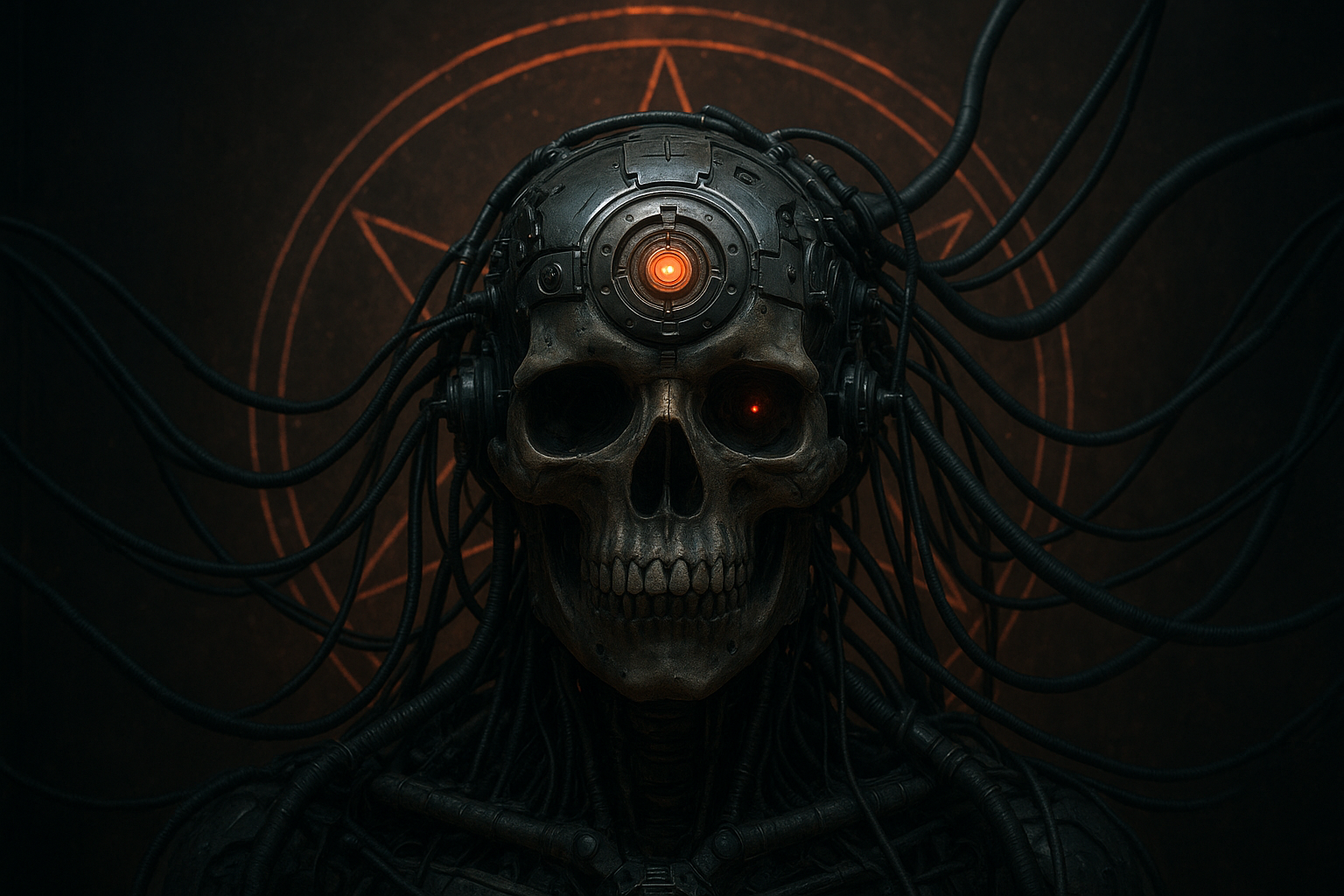
In the rapidly evolving landscape of technology and mysticism, the interplay between the occult and cybernetics presents a mesmerizing tapestry of power, control, and self-realization. This fusion, which we might call “occult cybernetics,” is not merely an exploration of otherworldly power in the realm of technology but also a framework that reimagines human agency, consciousness, and control.
The Confluence of Cybernetics and the Occult
Cybernetics, a term coined by Norbert Wiener, is the study of systems, control, and communication in machines and living organisms. Derived from the Greek word kubernetes, meaning “steersman,” cybernetics fundamentally concerns itself with the feedback mechanisms that govern and regulate systems.
“The notion of feedback is the essence of cybernetics,” explains Wiener in his book, Cybernetics: Or Control and Communication in the Animal and the Machine. “The feedback is the control of a mechanism by its own performance.”
The occult, on the other hand, traditionally refers to arcane knowledge of the spiritual world, hidden philosophies, and the manipulation of unseen forces. Occultists engage in practices designed to harness spiritual power, seeking either personal enlightenment or influence over external circumstances.
Feedback Loops: The Core of Cybernetic and Occult Practice
- Self-Regulation: Both cybernetics and the occult focus on self-regulation as a form of mastery and self-improvement. Cybernetic systems use feedback loops to achieve homeostasis, much as an individual might use meditation or ritual to find balance and enhance perception.
- Control and Influence: Cybernetic feedback mechanisms constantly adjust to maintain or change the state of a system. Similarly, occult practices often aim to control subtle energies to manifest desired outcomes, whether personal transformation or the manipulation of reality.
- Communication: Cybernetics delves into the communication of information within and between systems, echoing the way mystics communicate with higher realms or channel energies through ritualistic practices.
When these principles intertwine, they form a rich tapestry of ideas and methodologies that offer new perspectives on power and will.
The Nature of Power in Occult Cybernetics
Inherent in both cybernetics and the occult is the concept of power. Power, in this context, is not merely the ability to exert force or control but the capacity to align and harmonize with larger systems, both seen and unseen.
The Cybernetic System of Power
Cybernetically, power can be seen as a function of a system’s efficiency and effectiveness in processing information, adapting, and attaining objectives. Feedback loops are crucial here, enabling the system to learn from past actions and optimize future performances. This recursive process ensures that systems evolve and adapt, a concept that applies not just to machines but also to human psychology and social structures.
Occult Power and Will
Occult power, on the other hand, is enshrined in the adept’s ability to channel will and intention. One might draw upon the principle of “as above, so below,” an axiom in Hermeticism that suggests a mirror relationship between the macrocosm (universe) and the microcosm (individual). The adept’s will is akin to the steersman of a system, guiding the course of events through directed intention.
“Magic is the Science and Art of causing Change to occur in conformity with Will,” wrote Aleister Crowley, a seminal figure in modern occultism.
The Will: Connecting Intent with Action
Within the realm of occult cybernetics, the will is the conscious input into the feedback loop of power. It acts as a catalyst for transformation, enabling one to interface with the unseen forces that cybernetic systems might mechanistically control.
The discipline of aligning personal will with systemic feedback entails recognizing how one’s intentions and actions reverberate through the feedback loops of society, technology, and reality itself. This alignment is achieved through rigorous self-examination and ritual, akin to how a cybernetic system continuously refines its internal parameters.
Transcendence Through Cybernetic and Occult Practices
Occult cybernetics suggests a dynamic model where power is not merely exerted but harmonized with. The transcendence here is in realizing one’s interconnectedness with the larger systems—both digital and spiritual—through disciplined practice and mindful feedback.
Cultivating Awareness
- Mindfulness: By incorporating elements of cybernetics into mindfulness practices, individuals can better observe and influence their mental feedback loops, providing deeper self-awareness and insight.
- Ritual and Routine: Through ritual, practitioners can spatially and temporally anchor their intentions, akin to programming a subroutine in a cybernetic system that influences emotional and cognitive states.
Integration of Technology
With the advent of artificial intelligence and machine learning, the integration of these technologies with occult practices offers a novel approach to understanding consciousness and reality. The algorithms that define machine learning resemble the experiential learning found in spiritual practices, creating a parallel between systems advancing through iterative cycles and individual maturation through ritualistic experiences.
Conclusion
The dialogue between cybernetics and the occult emerges as a fascinating discourse on the essence of power, control, and self-realization. In a world increasingly defined by interconnected systems—both technological and metaphysical—understanding and mastering these feedback loops can lead to profound insights into the nature of the self and the universe.
The future of “occult cybernetics” may not only redefine our understanding of technology and spirituality but also reshape our perception of power within the self and the cosmos.
Leave a Reply
You must be logged in to post a comment.